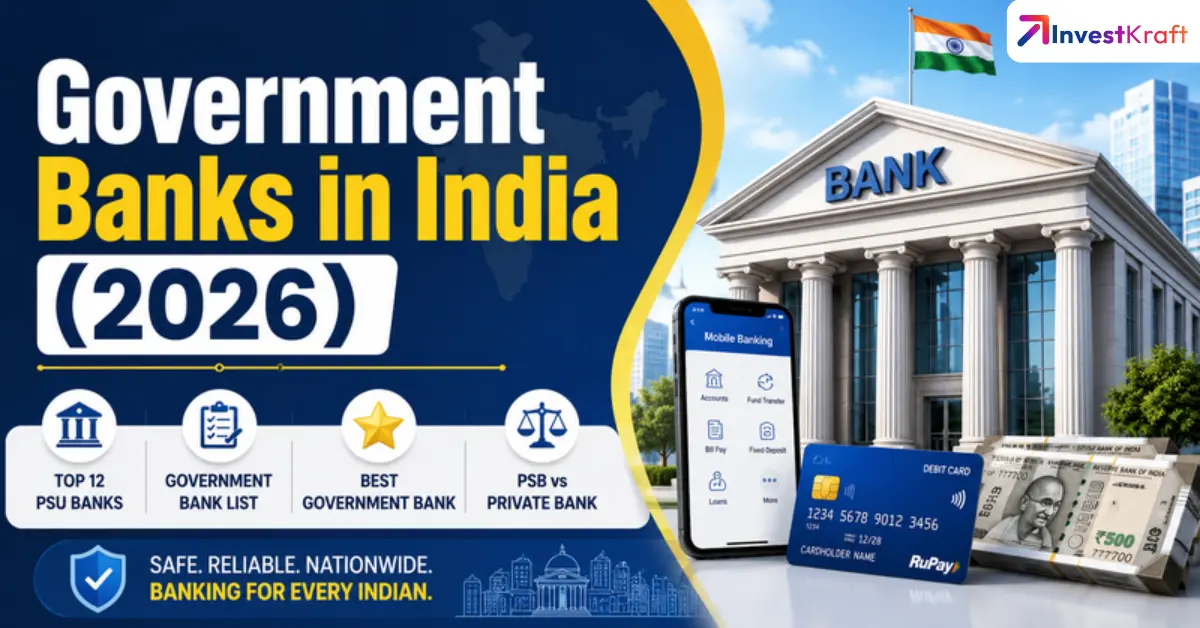
Government banks in India, also known as Public Sector Banks (PSBs), are banks where the Government of India holds a majority stake. These banks play a vital role in the country's banking system by providing secure savings accounts, loans, fixed deposits, digital banking, and various financial services to individuals and businesses.
As of 2026, there are 12 Public Sector Banks in India after a series of bank mergers initiated by the government. Among them, the State Bank of India (SBI) is the largest government bank in terms of assets, customer base, and branch network.
In this guide, you'll find the latest government bank list in India (2026), the top government banks, their key features, and how they compare with private sector banks to help you choose the right bank.
List of Government Banks in India (2026)
The following are the 12 Public Sector Banks (Government Banks) operating in India.
Government Bank
Headquarters
Established
Government Ownership*
State Bank of India (SBI)
Mumbai
1955
Majority
Punjab National Bank (PNB)
New Delhi
1894
Majority
Bank of Baroda
Vadodara
1908
Majority
Canara Bank
Bengaluru
1906
Majority
Union Bank of India
Mumbai
1919
Majority
Indian Bank
Chennai
1907
Majority
Bank of India
Mumbai
1906
Majority
UCO Bank
Kolkata
1943
Majority
Central Bank of India
Mumbai
1911
Majority
Punjab & Sind Bank
New Delhi
1908
Majority
Indian Overseas Bank
Chennai
1937
Majority
Bank of Maharashtra
Pune
1935
Majority
Note: Government shareholding may change over time due to disinvestment or regulatory updates.
Top Government Banks in India (2026)
While all government banks are regulated by the Reserve Bank of India (RBI), some stand out due to their financial strength, branch network, digital banking services, and customer trust.
1. State Bank of India (SBI)
State Bank of India is the largest government bank in India with thousands of branches and ATMs across the country.
Highlights
Largest branch network in India
Excellent digital banking through YONO SBI
Wide range of loan products
Strong rural and urban presence
Trusted by millions of customers
Best For: Savings accounts, salary accounts, home loans, personal loans, and digital banking.
2. Punjab National Bank (PNB)
Punjab National Bank is one of India's oldest public sector banks with a strong nationwide presence.
Highlights
Extensive branch network
Competitive loan products
Strong MSME banking
Multiple savings account options
Best For: Business banking and traditional banking services.
3. Bank of Baroda
Bank of Baroda is known for competitive interest rates and a growing digital banking ecosystem.
Highlights
Attractive home loan schemes
Modern mobile banking
International presence
Good customer support
Best For: Home loans and international banking.
4. Canara Bank
Canara Bank has strengthened its position after its merger with Syndicate Bank and offers a wide range of banking services.
Highlights
Good personal loan options
Strong education loan portfolio
Digital banking services
Extensive branch network
Best For: Personal loans, education loans, and retail banking.
5. Union Bank of India
Union Bank of India has significantly expanded after mergers and offers banking services across urban and rural India.
Highlights
Wide ATM network
Affordable loan products
Strong rural banking
Digital banking facilities
Best For: Rural customers and affordable banking services.
Which is the Best Government Bank in India?
The best government bank depends on your financial needs. Here's a quick comparison to help you decide.
Requirement
Recommended Government Bank
Best Overall
State Bank of India
Best Home Loan
Bank of Baroda
Best Personal Loan
Canara Bank
Best Digital Banking
State Bank of India
Best Rural Banking
Union Bank of India
Best Fixed Deposit
Indian Bank
Best Business Banking
Punjab National Bank
If you're looking for an all-round banking experience with excellent branch access, digital services, and a wide range of products, State Bank of India (SBI) remains the preferred choice for most customers.
Government Banks vs Private Banks
Both government and private banks offer similar banking products, but they differ in ownership, customer service, and operational approach.
Feature
Government Banks
Private Banks
Ownership
Government-owned
Privately owned
Trust
Very High
High
Branch Network
Extensive
Good
Rural Presence
Excellent
Limited in some areas
Digital Banking
Good
Generally more advanced
Customer Service
May vary
Often faster
Loan Processing
Moderate
Usually quicker
Government banks are generally preferred by customers who prioritize safety, nationwide accessibility, and long-term reliability, while private banks often focus on faster service and advanced digital experiences.
Public Sector Banks vs Nationalised Banks
Many people use the terms Public Sector Banks and Nationalised Banks interchangeably, but there is a slight difference.
Public Sector Banks (PSBs) are banks where the Government of India owns a majority stake.
Nationalised Banks are banks that were originally private but were taken over by the government through nationalisation.
Today, most nationalised banks are part of the broader category of Public Sector Banks. Therefore, while every nationalised bank is a public sector bank, the terms are not always identical in historical context.
Advantages of Government Banks
Government banks continue to be the preferred choice for millions of Indians due to several benefits.
High Customer Trust: Since the government holds a majority stake, customers often consider these banks highly reliable.
Extensive Branch Network: Government banks have a strong presence in metropolitan cities, towns, and rural areas, making banking services accessible across India.
Wide Range of Financial Products: Most government banks offer:
How many government banks are there in India in 2026?
There are 12 Public Sector Banks (Government Banks) in India as of 2026.
Which is the largest government bank in India?
State Bank of India (SBI) is the largest government bank in India based on assets, branches, and customer base.
Which is the best government bank in India?
For most customers, State Bank of India (SBI) is considered the best government bank due to its nationwide presence, comprehensive banking services, and robust digital platform.
Are government banks and public sector banks the same?
In most cases, yes. Government banks are commonly referred to as Public Sector Banks because the Government of India owns a majority stake in them.
Which government bank offers the best digital banking?
State Bank of India, through its YONO SBI platform, is widely recognized for offering one of the best digital banking experiences among public sector banks.
Government banks continue to be the backbone of India's banking sector, offering trusted financial services to millions of customers. With 12 Public Sector Banks operating in 2026, customers can choose from a wide range of options based on their banking needs, whether it's savings accounts, home loans, fixed deposits, or business banking.
If you're looking for the best overall government bank, State Bank of India (SBI) remains the top choice due to its extensive branch network, strong digital banking platform, and comprehensive range of financial products. However, banks such as Bank of Baroda, Punjab National Bank, Canara Bank, and Union Bank of India are also excellent options depending on your specific requirements.
By comparing features, services, and accessibility, you can select the government bank that best supports your financial goals in 2026.
Author: Diwakar Kumar Singh
Diwakar Kumar Singh is a BFSI specialist and finance writer with over 7 years of hands-on experience in financial research, content creation, and analysis.
A Gold Medalist in MBA (Marketing) from IMT, he combines deep analytical skills with practical insights gained from evaluating companies, IPOs, unlisted shares, financial ratios, and investment opportunities. Diwakar has personally analysed hundreds of financial instruments and market scenarios, which he uses to break down complex topics into clear, actionable advice.
He has authored numerous in-depth finance articles, published multiple books internationally, and contributed to research publications. His work focuses on helping everyday investors and readers make better-informed financial decisions through well-researched, evidence-based explanations that are always grounded in real-world application rather than theory alone.


 care@investkraft.com
 +91-9599071040
 +91-9797971876