Your car breaks down. Your child's school admission demands a large fee. A medical emergency hits without warning. Or maybe you just want to renovate your home before the monsoon arrives.
Whatever the reason, when salaried employees in India need money fast, a personal loan on salary slip is often the fastest, most accessible solution available.
No collateral. No long waiting periods. No complicated paperwork. Just your salary slip, a few documents, a decent credit score - and in many cases, money will be credited to your bank account within hours.
Personal loan interest rates typically range from 9.98% to 44% per annum. That is a wide range - and at what rate you get the loan depends entirely on how well you understand the system and how smartly you prepare before applying.
This guide tells you everything. How salary slips work as income proof, what the eligibility criteria are, which bank to approach based on your salary, exactly what documents you need, how to maximise your loan amount, and the smartest ways to get the lowest possible interest rate.
What is a Personal Loan on Salary Slip?
A personal loan on salary slip is an unsecured loan extended to salaried individuals on the basis of their monthly income - primarily verified through salary slips and bank statements.
Because there is no collateral involved, lenders rely heavily on your salary slip to assess two things:
How much you earn (which determines how much you can repay each month)
The stability of your employment (which determines the risk of your defaulting).
Your salary slip is not just a document. In the eyes of a lender, it is your financial identity card.
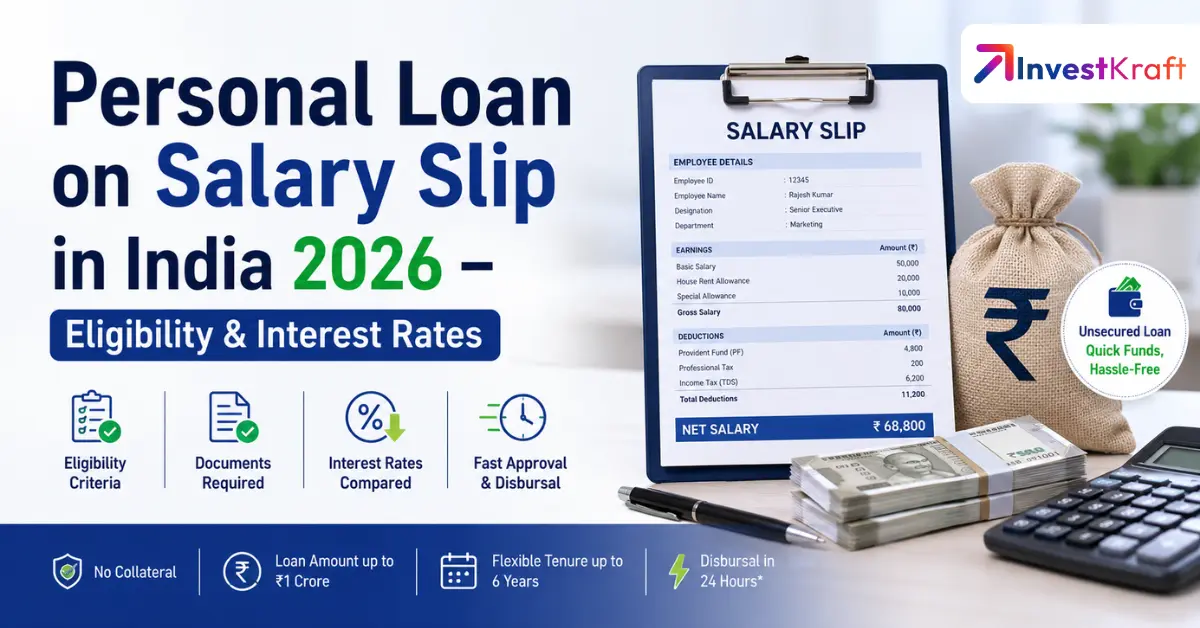
A salary slip confirms your employer's name, your designation, your gross and net salary, your deductions (PF, TDS, etc.), and your employment continuity.
All of this helps a lender decide in minutes whether to give you a loan - and at what interest rate.
Why 2026 Is a Good Year to Apply for a Personal Loan
Three factors make 2026 a favourable environment for personal loan borrowers:
RBI rate cuts: The RBI has reduced the repo rate to 5.25% following consecutive cuts in late 2025 and early 2026. While personal loan rates are largely fixed and not directly repo-linked, competition among lenders has pushed rates lower overall.
Digital lending: In 2026, lenders use digital tools for faster and more accurate credit profiling, making the loan process efficient - with end-to-end digital journeys reducing approval time from days to minutes for eligible applicants.
More lenders, more options: Banks and NBFCs are all competing aggressively for salaried borrowers. This competition benefits you - more choices, better rates, and more flexible eligibility.
Personal Loan Interest Rates on Salary Slip - Bank-by-Bank Comparison 2026
Let us compare the interest rates of personal loan on salary slip by various banks from the following table:
Lender
Interest Rate (per annum)
Max Loan Amount
Max Tenure
Minimum Salary
Kotak Mahindra Bank
Starting 9.98%
₹35 lakh
6 years
₹25,000/month
HDFC Bank
10.40% to 24.16%
₹40 lakh
5 years
₹25,000/month
ICICI Bank
Starting 10.50%
₹50 lakh
6 years
₹25,000/month
IDFC FIRST Bank
Starting 9.99%
₹1 crore
5 years
₹25,000/month
SBI (Xpress Credit)
Starting 10.00%
₹20 lakh
6 years
₹15,000/month
Axis Bank
Starting 10.49%
₹40 lakh
5 years
₹15,000/month
Bajaj Finserv
11% to 38%
₹35 lakh
8 years
₹25,000/month
IndusInd Bank
Starting 10.49%
₹50 lakh
6 years
₹25,000/month
Hero FinCorp
Starting 18%
₹5 lakh
4 years
₹15,000/month
Fibe / KreditBee (Fintech)
16% to 36%
₹5 lakh
3 years
₹12,000/month
Note: Rates as of April 2026 and are indicative. Final rates depend on your credit score, employer profile, loan amount, and the lender's policy at time of application. Always confirm directly with the lender.
Important Insight: Among leading private sector banks, Kotak Mahindra Bank offers the lowest interest rates on personal loans starting at 9.98% per annum, closely followed by HDFC Bank at 9.99% per annum onwards. The final rate depends on factors such as credit score, monthly income, and occupation profile.
How Much Personal Loan Can You Get on Your Salary?
This is the first question every borrower asks. The answer depends on two methods lenders use:
Method 1 - The Multiplier Method: Many lenders offer 10 to 24 times your net monthly salary as the loan amount.
Method 2 - The FOIR Method (More Common): FOIR stands for Fixed Obligation to Income Ratio. It measures how much of your monthly income is already committed to existing EMIs and fixed payments.
FOIR Formula
FOIR = (All existing EMIs + Proposed new EMI) ÷ Monthly Net Salary.
In 2026, an acceptable FOIR is usually up to 50 to 60 percent of net monthly income.
Example
If your monthly salary is ₹50,000 and your existing EMIs are ₹10,000.
Your available capacity for new EMI = 50% of ₹50,000 minus ₹10,000 = ₹15,000 per month At 12% interest over 5 years, a ₹15,000 EMI supports a loan of approximately ₹6.7 lakh.
Now, let us check an estimated loan eligibility based on the monthly net salary and the required CIBIL score:
Monthly Net Salary
Estimated Loan Eligibility (No Existing EMIs)
CIBIL Score Needed
₹15,000
₹1 lakh to ₹2.5 lakh
700+
₹20,000
₹2 lakh to ₹4 lakh
720+
₹25,000
₹3 lakh to ₹5 lakh
725+
₹30,000
₹5 lakh to ₹8 lakh
730+
₹50,000
₹8 lakh to ₹15 lakh
750+
₹75,000
₹12 lakh to ₹20 lakh
750+
₹1,00,000+
₹20 lakh to ₹40 lakh+
750+
Estimates only. Actual eligibility varies by lender, CIBIL score, employer profile, and existing obligations.
Minimum Salary Required for Personal Loan in 2026
The minimum salary is usually ₹15,000 to ₹25,000 per month to qualify for a personal loan from a mainstream lender. Banks generally look for applicants who earn ₹20,000 or more to increase chances of approval.
If your monthly salary is under ₹15,000, traditional banks will likely decline your application. But you still have options: fintech apps like Fibe and KreditBee accept salaries as low as ₹12,000 for small loans ranging from ₹5,000 to ₹2 lakh.
What Does Your Salary Slip Actually Tell the Lender?
Most borrowers think a salary slip is just a formality. It is not. Lenders extract critical information from every salary slip you submit.
Here is what they look at:
Employer Name and Category: Lenders usually offer preferential interest rates to salaried individuals as compared to self-employed applicants due to the former's higher income security. Within salaried applicants, government and PSU employees are offered lower interest rates than private sector employees due to the former's higher job security.
Your employer's name signals risk level. A government employee from NTPC and a junior employee from an unrecognised private firm will receive very different interest rate offers - even on the same salary.
Employer Category Hierarchy (Best to Least Preferred): Government / Central and State PSUs (lowest risk, best rates), Large listed companies and MNCs (very good), Reputed private sector companies in top employer lists, Mid-size established private companies, Small private firms, startups, unrecognised employers (higher rate or rejection)
Gross vs Net Salary: Most lenders use your net take-home salary (after all deductions) to calculate eligibility - not gross salary. If your gross is ₹50,000 but your take-home after PF, TDS, and other deductions is ₹38,000, lenders use ₹38,000 for calculation.
PF Deduction: Regular Provident Fund deductions indicate stable, formal employment - a positive signal for lenders.
TDS (Tax Deducted at Source) shows that your income is formally declared and tax-compliant - another trust signal.
Salary Continuity: Multiple months of salary slips (typically last 3 months) show income consistency, not a one-time large payment.
Checklist for Eligibility Criteria for Personal Loan on Salary Slip
Criteria
Typical Requirement
Age
21 to 60 years (some lenders up to 65)
Employment Type
Salaried (government, PSU, private, MNC)
Minimum Net Monthly Salary
₹15,000 to ₹25,000 (lender dependent)
Minimum Work Experience
6 months to 2 years in current job
CIBIL Score
700+ minimum; 750+ for best rates
FOIR
Below 50% to 60% of net monthly income
Citizenship
Indian Resident
Employment Stability
No frequent job changes
Special Note on Job Changes: Lenders assess the employment stability of an applicant when setting interest rates. Applicants who frequently change jobs are often considered to carry higher credit risks, which can lower their chances of approval or result in higher interest rates.
If you have recently changed jobs, wait for at least 6 months in your new role before applying. Ideally, 12 months of stability at your current employer gives the lender maximum comfort.
What is CIBIL Score and Why Does It Matter More Than Your Salary
Many borrowers assume that a high salary guarantees a personal loan. It does not.
Your CIBIL score - a three-digit number between 300 and 900 - is often the single most important factor in whether you get approved and at what rate.
Understanding how personal loans affect your credit score can help you maintain a healthy credit score through consistent repayment behaviour that improves future loan approval chances.
CIBIL Score and Its Impact on Personal Loans:
CIBIL Score
Approval Chances
Interest Rate Offered
800 and above
Excellent
Best rates - 9.98% to 11%
750 to 799
Very Good
Competitive - 10% to 13%
700 to 749
Good
Moderate - 12% to 18%
650 to 699
Fair
Higher - 16% to 24%
Below 650
Difficult
Very high or rejected
What makes up your CIBIL score?
Payment history (35%) - your track record of paying EMIs and credit card bills on time Credit utilisation (30%) - how much of your available credit limit you are using Length of credit history (15%) - how long you have been using credit Credit mix (10%) - a healthy mix of secured and unsecured loans New enquiries (10%) - too many loan applications in a short time hurts your score
Quick tip: Check your CIBIL score for free at cibil.com before applying. If your score is below 720, spend 3 to 6 months improving it before you apply - the interest savings will be significant.
Documents Required for Personal Loan on Salary Slip
Getting your documents ready in advance is the single easiest way to speed up approval. Here is the complete list:
Identity and Address Proof (KYC): Aadhaar Card (mandatory for most lenders), PAN Card (mandatory), Passport, Voter ID, or Driving Licence (any one as additional proof), Recent utility bill or bank statement as address proof
Income Proof: Last 3 months' salary slips (some lenders ask for 6 months), Last 6 months' bank statement of salary account, Form 16 for the last 1 to 2 financial years (some lenders), Latest ITR (for loan amounts above ₹10 lakh, some lenders ask for this)
Employment Proof: Current employer's ID card or offer/appointment letter. Employment continuity proof (joining letter, increment letter, etc.)
In case salaried applicants cannot furnish the salary slip for verification of income, some lenders do allow them to produce their bank statements to show regular salary credits as a substitute for physical salary slips.
Tip: Ensure your salary is credited to the bank account whose statement you are submitting. The salary credit in the bank statement must match the salary slip. Any mismatch is a common reason for rejection.
Step-by-Step Process to Apply for a Personal Loan on Salary Slip in 2026
Now, let us see the steps involved in getting a loan on a salary slip:
Step 1: Check Your CIBIL Score. Visit the official CIBIL website for a free credit report. Know where you stand before approaching any lender.
Step 2: Calculate Your Eligibility: Use a personal loan EMI calculator - available on the websites of HDFC Bank, SBI, Paisabazaar, and BankBazaar - to estimate the loan amount your income can support. Enter your monthly salary, existing EMIs, desired loan amount, and tenure to instantly see your approximate EMI and eligibility.
Step 3: Compare Lenders. Do not apply to the first lender you find. Choosing the right personal loan lender is as important as getting a lower interest rate. Compare rates, processing fees, and tenure options on aggregator platforms like Paisabazaar or BankBazaar. Choosing HDFC Bank at 9.99% over Bajaj Finserv at 13.5% on a ₹5 lakh loan saved one borrower over ₹53,000 in total interest - a small difference in rate matters enormously.
Step 4: Check Pre-Approved Offers First. If you have a salary account or an existing relationship with a bank, check if you have a pre-approved personal loan offer. Many lenders offer interest rate concessions or pre-approved instant personal loans at lower interest rates to applicants with whom they have existing lending, deposit, or credit card relationships. Pre-approved loans mean faster approval and less documentation.
Step 5: Apply Online. Most banks and NBFCs now offer fully digital applications. You can apply via the bank's website, their mobile app (SBI YONO, HDFC Bank app, ICICI iMobile), or through an aggregator platform. The process typically takes 10 to 20 minutes.
Step 6: Upload Documents. Upload your KYC, salary slips, and bank statements as required. Ensure documents are clear, readable, and match the information in your application.
Step 7: Complete Video KYC (if required). Many lenders now conduct a quick video KYC instead of a physical branch visit - a 5 to 10 minute video call where you hold up your PAN card and verify your identity.
Step 8: Receive Approval and Sign Agreement. For eligible profiles, approval can come within minutes to hours. Review the loan agreement carefully - check the interest rate, tenure, processing fee, and prepayment conditions before signing.
Step 9: Loan Disbursement. Once the agreement is signed, funds are disbursed to your bank account. Instant personal loans are designed for quick approval and disbursal, often within hours. For standard applications, disbursal typically happens within 1 to 2 working days.
Personal Loan on Salary Slip Without Physical Slip - Is It Possible?
Yes. Yes. If you do not receive formal payslips from your employer, you can also explore options for a personal loan without salary slip offered by some NBFCs and digital lenders.
Here is what you can do:
Option 1: Bank Statement as Substitute. Some lenders do allow salaried applicants to produce bank statements to show regular salary credits as a substitute for physical salary slips. If your salary is consistently credited every month with the same label (such as your employer's name), lenders can verify income from the statement alone.
Option 2: Form 16. Form 16 is a TDS certificate issued by your employer annually. It confirms your salary and tax deductions - a strong income document that some lenders accept in lieu of monthly salary slips.
Option 3: Employment Letter with Bank Statement. An official appointment letter stating your CTC (Cost to Company), combined with 6 months of bank statements showing regular salary credits, can satisfy most NBFC requirements.
Option 4: NBFCs and Fintech Lenders. If you work at a small company that does not issue formal salary slips, NBFCs and fintech lenders are generally more flexible than banks about documentation. They may approve your loan based on salary credits in bank statements, GST data (if applicable), and credit bureau data.
How to Get the Lowest Interest Rate on Your Personal Loan
This section can save you lakhs. The difference between 10.5% and 16% on a ₹5 lakh loan over 5 years is approximately ₹90,000. Here is how to negotiate your way to the bottom of the rate band:
Keep Your CIBIL Score Above 750: This is non-negotiable. A score above 750 unlocks the lowest rate slabs. Pay all existing EMIs and credit card bills on time, every month.
Apply With Your Salary Account Bank First: Existing customers of the bank may be offered a lower rate of interest, provided they have a good relationship with the loan provider. Your salary bank already has your income data and trusts your account - use that relationship.
Reduce Your FOIR Before Applying: Pay off any small existing loans or credit card balances before applying. A lower FOIR signals lower risk and can unlock better rates and higher loan amounts.
Avoid Multiple Applications: The hard inquiry happens as soon as an applicant applies to a lender, and they check the applicant's credit history. Multiple hard inquiries in a small timeframe may damage your credit rating and could cause you to be offered higher interest rates. Use soft eligibility checks on aggregator platforms before committing to a formal application.
Choose a Shorter Tenure: A 3-year tenure on the same loan often attracts a slightly lower rate than a 5-year tenure, because the lender's risk exposure is shorter.
Look for Festive Offers: Special offers on interest rates during festive seasons or for existing customers are common. Many banks run reduced-rate or zero-processing-fee campaigns during Diwali, Dussehra, and the financial year-end.
Negotiate: If you are a long-standing customer with a good repayment track record, simply call your bank's loan department and ask for a better rate. It works more often than people think.
Personal Loan EMI Calculator - Plan Before You Borrow
Before you apply for any personal loan, use an online Personal Loan EMI Calculator. It is free, available on every bank's website, and takes less than a minute. Simply enter: Your desired loan amount, the interest rate being offered & your preferred tenure (in months or years)
The calculator instantly shows you: Your monthly EMI, Total interest payable over the tenure & Total amount payable (principal + interest)
An Example of an EMI Table for a ₹5 Lakh Personal Loan
Interest Rate
2 Years
3 Years
4 Years
5 Years
10%
₹23,072
₹16,133
₹12,679
₹10,624
12%
₹23,536
₹16,607
₹13,166
₹11,122
15%
₹24,244
₹17,333
₹13,915
₹11,895
18%
₹24,959
₹18,072
₹14,684
₹12,694
The right EMI is the one that keeps your total FOIR below 50% of your monthly take-home salary. Always run the numbers before signing.
Charges You Must Know Before Taking a Personal Loan
The interest rate is just one cost. Here are all the charges to account for:
Charge
Typical Range
Notes
Processing Fee
0.5% to 3% of the loan amount + GST
Non-refundable. HDFC charges up to ₹6,500 + GST
Prepayment / Foreclosure Fee
2% to 5% of outstanding + GST
Check if your lender allows prepayment after 6/12 months
Bounce / Late Payment Charge
₹500 to ₹1,500 per instance
Damages your credit score, too
Stamp Duty
State-specific
Mandatory, non-refundable
GST on all service charges
18%
Applicable to processing fee, prepayment charges, etc.
Amortisation Schedule
₹50 per physical copy (HDFC)
Free online download
What to always check in the loan agreement: Is the interest rate fixed for the entire tenure? What is the lock-in period before you can prepay? What is the exact prepayment charge after lock-in? Are there any hidden charges not mentioned upfront?
Government Employees vs Private Sector - Who Gets a Better Deal?
Government and PSU employees have a significant advantage when applying for personal loans. Here is why:
Feature
Government / PSU Employee
Private Sector Employee
Interest Rate
Typically 0.5% to 1.5% lower
Standard market rate
Minimum Salary Requirement
Often relaxed
Strictly enforced
Loan Amount
Higher multiples of salary
Standard multiples
Processing
Often faster with special schemes
Standard process
Job Security Assessment
Highest - no risk of layoffs
Assessed individually
SBI, in particular, has special schemes for central and state government employees, defence personnel, and PSU employees - often with pre-approved limits and negligible processing fees.
Common Reasons Personal Loans Are Rejected - and How to Avoid Them
Low CIBIL Score: The most common reason. Anything below 700 significantly reduces approval chances. Solution: check your score before applying and work on improving it.
High FOIR: Your existing EMIs eat up too much of your income. Solution: pay off smaller existing loans before applying.
Frequent Job Changes: Lenders see unstable employment as a risk. Solution: stay in your current job for at least 12 months before applying.
Loan Amount Too High: Applying for more than your income supports triggers rejection. Solution: Use the EMI calculator to apply for a realistic amount.
Multiple Applications in a Short Period: Each hard enquiry dents your credit score. Solution: Use pre-approval checks first, then apply selectively.
Mismatch in Documents: Salary slip and bank statement amounts do not match, or the name spelling differs across documents. Solution: double-check all documents for consistency before submission.
Unsatisfactory Employer Profile: Your company is on a lender's negative list. Solution: check if the lender accepts your employer type before applying; approach an NBFC if banks reject you.
Summary
A personal loan on salary slip in 2026 is faster, more accessible, and more competitive than ever - but getting the best deal requires preparation. Here is a quick recap of everything covered in this guide:
What it is: An unsecured loan for salaried employees, approved primarily on the basis of salary slips, bank statements, and credit score.
Interest rates in 2026: Starting from 9.98% (Kotak, HDFC) to 44% at fintech lenders - your rate depends entirely on your credit profile.
Minimum salary: ₹15,000/month for NBFCs and PSU banks; ₹25,000/month for most private banks.
CIBIL score: 750+ for the best rates; 700 to 749 for standard approval; below 700 expect difficulty.
FOIR rule: Your total EMIs - including the new loan - should not exceed 50% to 60% of your net monthly salary.
Key documents: Aadhaar, PAN, last 3 months' salary slips, last 6 months' bank statements, employer ID.
Fastest route to approval: Apply with your salary account bank; check pre-approved offers first.
Lowest rate strategy: CIBIL 750+, reduce existing EMIs, choose shorter tenure, apply with the right lender, and negotiate.
Use a calculator: Always calculate your EMI and total interest cost before signing. Free calculators are available on every major bank's website.
Read the agreement: Check the processing fee, prepayment charges, and lock-in period before you sign anything.
Frequently Asked Questions
Can I get a personal loan on just a salary slip?
Yes. Most lenders approve personal loans using salary slips, bank statements, and KYC documents. If you do not have a salary slip, some lenders may accept bank statements showing regular salary credits.
What is the minimum salary for a personal loan in India in 2026?
Most banks require a minimum monthly salary of ₹15,000 to ₹25,000. Fintech lenders may accept lower salaries, but loan amounts and approval chances may be limited.
How much personal loan can I get on a ₹30,000 salary?
With a ₹30,000 monthly salary and a good CIBIL score, you may get a personal loan of around ₹5 lakh to ₹8 lakh, depending on your existing EMIs and lender policy.
Does applying for a personal loan affect my CIBIL score?
Yes. Every loan application creates a hard enquiry, which may slightly reduce your CIBIL score. Multiple applications in a short period can impact your score further.
How quickly can I get a personal loan on my salary slip?
Many banks and fintech lenders offer approval within minutes to hours. Loan disbursal usually happens within the same day or 1–2 working days.
Can I get a personal loan if I am new to a job?
Yes, but most lenders prefer at least 6 months in the current job. Applicants with stable employment and a good credit score have better approval chances.
What is FOIR and how does it affect my personal loan eligibility?
FOIR (Fixed Obligation to Income Ratio) measures how much of your salary goes toward EMIs. Most lenders prefer FOIR below 50%–60% to approve a personal loan.
Sources
All information in this article has been sourced from official and verified sources:
Paisabazaar - Personal Loan Interest Rates (April 28, 2026): paisabazaar.com/personal-loan/interest-rates
BankBazaar - Personal Loan Interest Rates (April 2026): bankbazaar.com/personal-loan-interest-rate.html
HDFC Bank - Personal Loan Interest Rates and Charges: hdfc.bank.in/personal-loan/interest-rates-and-charges
SBI Personal Loan (Xpress Credit) - Rates and Eligibility: bankbazaar.com and sbi.co.in
ICICI Bank - Personal Loan Interest Rates: icicibank.com
IDFC FIRST Bank - Personal Loan Interest Rates (April 2026): idfcfirst.bank.in
DMI Finance - Personal Loan Interest Rates in 2026: dmifinance.in/personal-loan-interest-rates-in-2026
Piramal Finance - Documents Required for Personal Loan: piramalfinance.com/personal-loan/documentation-for-personal-loan
Saarathi FinBiz - Personal Loan Eligibility for Salaried Employees 2026: saarathi.ai
GoCredit - Minimum Salary for Personal Loan India 2026: gocredit.money
CIBIL - Credit Score Guidelines: cibil.com
FinCrif - Personal Loan Interest Rate Comparison (February 2026): fincrif.com
Disclaimer
Interest rates, processing fees, minimum salary requirements, and eligibility criteria mentioned in this article are indicative as of April 2026 and are subject to change at the discretion of individual lenders. This article is for informational purposes only and does not constitute financial advice. Always verify current terms and conditions directly with the lender or consult a qualified financial advisor before applying for any loan.
Author: Diwakar Kumar Singh
Diwakar Kumar Singh is a BFSI specialist and finance writer with over 7 years of hands-on experience in financial research, content creation, and analysis.
A Gold Medalist in MBA (Marketing) from IMT, he combines deep analytical skills with practical insights gained from evaluating companies, IPOs, unlisted shares, financial ratios, and investment opportunities. Diwakar has personally analysed hundreds of financial instruments and market scenarios, which he uses to break down complex topics into clear, actionable advice.
He has authored numerous in-depth finance articles, published multiple books internationally, and contributed to research publications. His work focuses on helping everyday investors and readers make better-informed financial decisions through well-researched, evidence-based explanations that are always grounded in real-world application rather than theory alone.
 care@investkraft.com
 +91-9599071040
 +91-9797971876