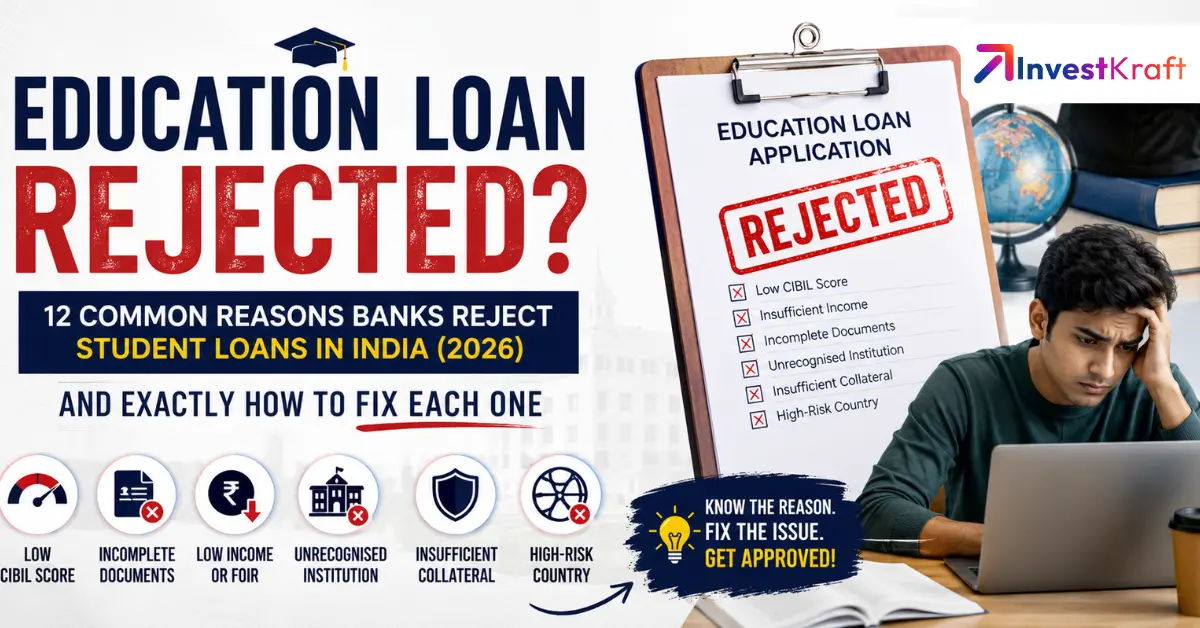
You have worked for years to get into a good college. You have your admission letter in hand. You have calculated the costs, approached a bank, submitted your application, and then comes the reply that stops everything cold.
Rejected.
No clear reason. No roadmap. Just a vague "does not meet eligibility criteria" - and a ticking clock before your seat at the university is at risk.
Here is a number that puts this in perspective: roughly 35% of education loan applications in India are rejected.
That is more than one in three students who apply. And the hardest part? Banks rarely explain their rejection clearly. A vague response leaves students and families guessing, sometimes reapplying with the same flawed file and collecting fresh rejections that quietly damage the co-applicant's credit score.
The good news is that education loan rejection is rarely permanent. Every reason has a fix. Before applying, students should also understand what an education loan is and how it works, including repayment terms, moratorium period, and lender eligibility criteria. But you need to know the exact reason first - and that is what this guide is for.
Read this before you apply - or immediately after a rejection.
Why Do Banks Reject Education Loans? The Big Picture
Education loans in India are facing a concerning rise in Non-Performing Assets (NPAs). As of June 2022, about 8% of education loans granted by public sector banks, including SBI, Canara, UBI, and IOB, had turned into NPAs, amounting to ₹6,246 crore.
This NPA crisis has made banks significantly more careful. Banks have tightened their underwriting considerably since a period when Non-Performing Assets in education loans reached concerning levels in the Indian banking system. The result is that lenders now scrutinise files more carefully at multiple stages. In simple terms, banks are not being difficult. They are being careful with money that must eventually come back. Understanding this mindset helps you understand every single rejection reason below.
Overview of Top Reasons for Education Loan Rejection in India 2026
The following table explains the top reasons for education loan rejection:
Reason
Who It Affects Most
Fixable?
Low CIBIL Score (Co-applicant)
All borrowers
Yes - takes 3 to 12 months
Unstable or Low Co-applicant Income
Students with informal-sector parents
Yes - add second co-applicant
Unrecognised or Low-Ranked Institution
Students going abroad
Yes - choose an approved university
Incomplete or Incorrect Documentation
All borrowers
Yes - fix in days
Insufficient Collateral
High-value loan seekers
Partially - revalue or switch
Poor Academic Record
Below-average students
Partially - explain gaps
Unapproved Course or Field of Study
Arts, Humanities, and certain MBBS
Yes - choose an approved course
High-Risk Country for Study
Students going to risky geographies
Yes - reconsider destination
Multiple Loan Applications Simultaneously
All borrowers
Yes - stop immediately
Age or Course Duration Issues
Older students, long courses
Partially - approach NBFCs
Forged or Mismatched Documents
Rare but severe
No - prevention only
Low Language Proficiency Scores
International education seekers
Yes - retake the test
Now, let us understand these reasons for education loan rejection and their fixes in detail.
Reason 1: Low CIBIL Score of the Co-Applicant - The Number One Killer
This is the single most common reason for education loan rejection in India - and it catches thousands of families off guard because the student's credit score is not the primary concern. It is the parent's (co-applicant's) score.
Most students applying for an education loan are 18 to 22 years old and have no credit history at all. Banks know this. So they shift their entire credit risk assessment to the co-applicant - typically a parent or guardian.
Lenders ask for good credit scores of both the student and the co-applicant. Usually, a score of 700 or higher is considered the benchmark for education loans. If you are unsure how lenders interpret credit profiles, read our guide on understanding credit scores and ranges.
The minimum CIBIL score of the co-applicant must be 650 or above to get an education loan from banks and NBFCs. However, 650 is the bare minimum - not the comfort zone. Scores above 700 significantly improve your chances, and 750+ can unlock better terms and lower interest rates.
What damages a parent's CIBIL score?
Missed EMI payments on home loans, car loans, or credit cards. Loan defaults or settlements in the past. High credit card utilisation (above 30% of the credit limit), too many credit applications in a short period, old unpaid dues, or even a forgotten credit card with a small outstanding balance.
How to Fix
Check the co-applicant's CIBIL score immediately at the CIBIL official website (free once a year).
If it is below 700, do the following before applying: Pay off any overdue EMIs or credit card balances completely
Avoid taking any new loans or credit cards in the 6 months before applying
Reduce credit card usage to below 30% of the total limit
If the score cannot be fixed quickly enough, add a second, financially stronger co-applicant such as an employed sibling, aunt, uncle, or grandparent.
Reason 2: Unstable or Insufficient Co-Applicant Income
Even a good CIBIL score is not enough if the co-applicant's income cannot support the projected EMI repayments.
Even with a good CIBIL score, a co-applicant whose income is too low to service the projected EMI will trigger a rejection. Lenders generally calculate the FOIR (Fixed Obligation to Income Ratio), and the co-borrower must submit salary proof and ITR showing a minimum monthly earning of ₹30,000 to ₹35,000 for education loans from private banks or NBFCs.
The FOIR calculation works as follows: if a co-applicant earns ₹50,000 per month but already pays ₹25,000 in home loan EMIs and ₹8,000 in car loan EMIs, their existing obligations consume 66% of income. A bank approving a new education loan EMI on top of that carries high risk - the co-applicant would have almost no financial buffer. Most banks cap FOIR at 50 to 60% of monthly income.
Income instability is also a red flag. Self-employed parents with irregular income, daily wage earners, farmers with no formal income proof, and small business owners without ITR filing are all at high risk of triggering rejection on this ground.
How to Fix
File ITR (Income Tax Return) consistently for the last 2 to 3 years - even if income is modest, a documented track record of earnings helps enormously.
If one parent's income is insufficient, both parents can be co-applicants - their combined income is considered.
Add an employed sibling or other earning family member as an additional co-applicant.
Pay off any existing large EMIs before applying to improve the FOIR calculation.
Approach NBFCs and specialised education loan companies that have more flexible income documentation norms than public sector banks.
Reason 3: Unrecognised, Low-Ranked, or Blacklisted Institution
Student loans are targeted at a selected list of universities and courses. Applications for unrecognised institutes or institutes without a good placement record are often rejected. In the lender's view, a less reputable institution has restricted future job prospects and academic standards. Many lenders maintain a list of eligible institutions for an education loan to standardise their evaluation process.
This particularly affects students going abroad. A university that is not QS-ranked, not recognised by major accreditation bodies, or does not appear on the bank's approved institution list will almost always result in rejection, regardless of how good the student's profile is.
Banks prefer financing courses that have a high likelihood of leading to employment and stable income. Courses with low employment rates or institutions with poor placement records can be a cause for rejection.
What kinds of institutions get flagged?
Universities not ranked on QS World University Rankings, THE, or ARWU Colleges blacklisted after previous NPA issues. Diploma mills or unaccredited online institutions, some private deemed universities in India with poor placement records, institutions in countries that are not on the bank's approved country list.
How to Fix
Before choosing a university, check whether it is on the approved list of your target lender. SBI, for instance, publishes lists of approved foreign universities. GyanDhan and WeMakeScholars maintain updated databases of which universities are accepted by which lenders.
Use resources like the QS World Rankings to select a university that lenders are comfortable with. A university ranked in the global top 1000 in QS is rarely an issue. Institutions below that need verification.
Reason 4: Incomplete, Incorrect, or Mismatched Documentation
Insufficient documentation is one of the most common reasons for an education loan rejection. Documentation is an essential part of the education loan process, especially when it comes to collateral education loans from government banks.
This reason is particularly frustrating because it is entirely preventable - yet it causes thousands of rejections every year.
Common documentation mistakes
Submitting 3 months of bank statements when the lender requires 6 months
Name spelling that differs across Aadhaar, PAN, marksheets, and admission letter (even one letter difference matters)
Missing occupancy certificate for the property pledged as collateral
Outdated or unofficial copies of marksheets instead of attested originals
An admission letter from the university, which is a soft copy, when the lender requires a hard copy with an official seal
Missing the fee structure document from the institution
Income proof that does not match the declared income (bank deposits do not align with stated salary)
False documents - banks commence verification exercises to secure the credibility of documents submitted by the borrower.
False documents can be one of the reasons why education loans get rejected.
How to Fix
Create a complete document checklist before applying. Here is the standard list:
Student Documents: Aadhaar Card and PAN Card, 10th, 12th, and graduation marksheets (attested), Proof of admission - offer letter or admission letter from the institution, Fee structure from the university (official letterhead), Scholarship letters (if any), Entrance exam scorecards (GRE, GMAT, IELTS, TOEFL, etc.) & Passport (for abroad education)
Co-applicant Documents: Aadhaar Card and PAN Card, Last 3 months' salary slips (for salaried), Last 6 months' bank statements, ITR for last 2 to 3 years, Property documents (for collateral loans), Employment certificate or business proof
Note: Double-check that the name spelling matches exactly on every document. Even a minor discrepancy - "Suresh" vs "Suresh Kumar" - can trigger rejection or significant delays.
Reason 5: Insufficient or Ineligible Collateral
For loan amounts above ₹7.5 lakh (for most banks) and especially for large overseas education loans above ₹20 to 40 lakh, collateral is mandatory.
One of the most common reasons for loan rejection is the inadequacy of collateral. Banks have strict guidelines for the minimum value of collateral required against a loan amount. If the value of the pledged asset does not meet the required loan amount, the application may be rejected. For instance, if a student applies for an education loan of ₹60 lakh and pledges a house as collateral, but upon evaluation the property is valued at only ₹50 lakh - since the collateral does not cover the loan amount, the bank rejects the application.
What types of collateral are commonly rejected?
Agricultural land - not accepted by most banks Rural or peri-urban property with disputed title Property in a litigation (court case pending) Property without proper construction approval or occupancy certificate Commercial property that does not meet the bank's LTV (Loan to Value) norms Fixed deposits belonging to a third party (not the co-applicant or family member) The most missed document for collateral loans is the Occupancy Certificate (or Approved Map in some regions), which confirms legal construction of the property.
How to Fix
Get a professional property valuation done before submitting your loan application - so you know the bank's likely assessed value and whether it will cover your loan requirement.
Ensure all property documents are complete: sale deed, title documents, approved building plan, occupancy certificate, and latest property tax receipts. If the property value is borderline, consider pledging additional collateral - a Fixed Deposit combined with property, for instance, can together satisfy the bank's requirement.
If collateral is a genuine constraint, explore collateral-free education loans from NBFCs like HDFC Credila, Avanse, and InCred - which assess loan eligibility differently, often on the basis of the institution and course quality rather than just collateral.
Reason 6: Poor Academic Record or Excessive Backlogs
Banks are in the business of lending to students who are likely to graduate, get employed, and repay the loan. A student with a weak academic track record raises the question:
Will this investment pay off?
Your student loan application may get rejected due to poor academic performance. If you repeatedly fail in subjects, are unable to finish your course on time, or score less than the minimum marks - usually 50% or more - set by the lender, your education loan might be rejected.
If your marks in Class 10, 12, or graduation are below 40%, your loan application may be rejected. Backlogs or failed years may also raise red flags, as they indicate a higher risk of non-repayment.
How to Fix
For most banks, 50% aggregate marks is the minimum threshold. Some banks specify 60%.
If you have a legitimate reason for a low-scoring year - medical illness, family emergency, bereavement - write a formal explanation letter and attach supporting documentation. Banks do consider contextual explanations.
If you have backlogs but have cleared them all before applying, ensure you have the backlog clearance certificate from your institution.
Consider approaching private NBFCs and specialised education loan providers who give more weight to the quality of the institution and the course than to past academic marks.
A student who has consistently performed well and has gained admission to a premier institute has increased chances of getting an education loan. Banks believe that students from better academic backgrounds have higher employability and are more likely to repay the loan.
Reason 7: Unapproved or Low-Employability Course
Not every course is treated equally by lenders. Banks prefer courses that lead to clear, measurable employment outcomes - and they are cautious about everything else.
Certain courses, especially those with low employability prospects, can be a reason for education loan rejection. Lenders typically prefer STEM courses, Management Programs like MBA, and Job-Oriented Courses like medicine and law.
Courses that lenders strongly prefer
Engineering (B.Tech, M.Tech, MS)
Medicine (MBBS - though loan amounts and tenure need careful structuring)
Management (MBA, PGDM from reputed institutions)
Law (from reputed national law schools)
Data Science
Artificial Intelligence
Technology programs
Finance
Accounting (CFA, CA)
Courses that sometimes face rejection
Fine Arts, Film Studies, or purely creative programs from lesser-known institutions Certain Humanities or Social Sciences courses without clear career pathways PhD programs (very long duration - some lenders avoid these) Courses with limited career opportunities may be deemed less viable, leading to rejection of the loan.
How to Fix
Research the bank's approved course list before applying. Many banks publish these on their websites. If your course is not listed, ask a loan counsellor at GyanDhan or WeMakeScholars - they can identify which lender is most likely to fund your specific course.
If your course is in a less conventional field, strengthen the application by choosing a highly reputed institution. A Fine Arts degree from a globally ranked institution carries far more lender confidence than the same degree from an unrecognised college.
Reason 8: High-Risk Country or Study Destination
A major reason why your education loan application might get rejected is that the lender might not approve of the country where you want to study. Lenders or financial institutions have a list of countries for which they approve education loans.
For students planning to study abroad, geopolitical factors can influence loan approval. Banks may be hesitant to approve loans for countries with political instability, stringent visa regulations, or economic uncertainties. These factors can affect the student's ability to complete their education and secure employment, increasing the risk for lenders.
Countries typically well-accepted: USA, UK, Canada, Australia, New Zealand, Germany, Ireland, Singapore, France, Netherlands, Sweden, and most Western European nations.
Countries that face increased scrutiny or outright rejection
Ukraine (post-conflict situation)
China (student visa and employment concerns)
Afghanistan, Iran, and other conflict zones
Some Eastern European countries with less globally recognised degrees
Lenders prefer countries with stable education systems and strong job prospects. Applications for countries like Ukraine, China, or Afghanistan may face rejection due to perceived risks.
How to Fix
Before choosing an international university, verify that the destination country is on your target bank's approved country list. SBI Education Loan, for instance, has a specific list of approved countries for its Global Ed-Vantage scheme.
If your target country faces scrutiny, approach NBFC lenders who have more flexible country eligibility - HDFC Credila and Avanse, for example, cover a wider geography than public sector banks.
This is a mistake many desperate families make after a first rejection - they apply to 5 to 6 banks simultaneously, hoping one will say yes.
Applying to many banks at once may look like a smart move, but it can actually hurt your chances. Multiple applications can create trust issues and impact the credit score.
Every formal loan application triggers a hard enquiry on the co-applicant's CIBIL report. Each hard enquiry reduces the score by 5 to 15 points. Multiple enquiries in a short period signal to lenders that the applicant is credit-hungry or is being rejected repeatedly - both red flags. Students should first use a free CIBIL score check before applying to multiple lenders.
How to Fix
Use soft eligibility checks before formally applying - available on platforms like Paisabazaar, BankBazaar, and GyanDhan - these show you your approval chances without affecting the credit score.
Apply to a maximum of 2 lenders at a time, strategically chosen based on your profile. Wait for a response before approaching the next one.
The 48 hours after a rejection are critical. Most students either do nothing or immediately fire off applications to multiple banks, which creates fresh credit inquiries and compounds the problem.
Get the rejection reason in writing. SBI branches must give you a written reason for rejection. All regulated lenders in India are required to communicate the reason. If the branch officer gives you a vague verbal explanation, request a formal written rejection note. You cannot fix a problem you cannot name.
Reason 10: Insufficient Language Proficiency Scores (For Abroad Loans)
For international education, proof of language proficiency - such as IELTS or TOEFL for English-speaking countries - is mandatory. Unsatisfactory scores can lead to rejection.
Most banks require a minimum IELTS score of 6.0 to 6.5 (band-wise) for education loans for English-speaking countries. If you have not yet taken the test, or your scores fall below the threshold, the loan application may be held or rejected.
This is because low language scores suggest the student may struggle to complete the course - increasing the risk of dropout and default.
How to Fix
Take your IELTS, TOEFL, or equivalent test well in advance. Aim for IELTS 6.5 or above. Prepare thoroughly - there are many affordable preparation resources available online and offline.
Do not submit your loan application before your language test results are available. A complete application is a stronger application.
Reason 11: Student's Age or Extremely Long Course Duration
Sometimes, students applying at a later age or for very long-duration courses face rejection.
Most banks have a maximum age limit for education loan applicants - typically 35 to 40 years at some public sector banks. If you are pursuing higher education as a career change in your late 30s, some banks may be uncomfortable with the risk profile.
Similarly, very long courses - a 6-year MBBS abroad, a 5 to 7 year PhD program - stretch the repayment timeline significantly. Banks need to see a realistic path from study completion to employment to EMI repayment.
How to Fix
For older applicants or long courses, NBFCs tend to be more accommodating than public sector banks.
For PhD programs, look at specialised academic loans or fellowship-backed financing - some universities offer internal funding options.
If the course duration is long, show the bank a realistic financial plan - expected income post-graduation, letter of employment intent from a supervisor, or similar documentation that demonstrates you have thought through the repayment path.
Reason 12: Guarantor Is a Foreign National or Non-Resident
If the guarantor is a foreign national, the education loan application would be rejected. For the loan application to be approved, the applicant, co-applicant, and guarantor must be residents of the country and should come under the range of income tax laws. However, people who are currently living abroad but whose income falls under the jurisdiction of income tax authorities are qualified to be guarantors or co-applicants.
This is a niche but important point for families where one parent is working abroad. If your parent is an NRI and their income is not assessable under the Indian income tax law, they may not be accepted as a co-applicant by Indian banks.
The Fix
If a parent is an NRI, check whether their income falls under the Indian tax jurisdiction. If both parents are abroad, a grandparent, uncle, or sibling who is an Indian resident and has a stable income can serve as a co-applicant.
Some private sector banks and NBFCs do allow NRI co-applicants under specific conditions - verify this directly with the lender before applying.
What to Do Immediately After a Rejection
After a rejection, firstly, do not lose your motivation and create the following action plan:
Step 1: Request a written rejection letter from the bank. Under RBI guidelines, regulated lenders must provide a reason for rejection.
Step 2: Identify the exact reason. Map it to one or more of the issues listed in this guide.
Step 3: Do not reapply immediately. Fix the root cause first - whether it is the credit score, documentation gap, or wrong lender choice.
Step 4: Consult a specialist. Platforms like GyanDhan, WeMakeScholars, and Avanse Education Loans offer free counselling and can identify which lender is most suitable for your specific profile.
Step 5: Consider alternative lenders. The following table shows some:
Lender Type
Best For
Key Advantage
Public Sector Banks (SBI, Canara, Bank of Baroda)
Domestic and collateral-backed loans
Lowest interest rates; CIBIL-forgiving if collateral is strong
The following are some of the important tips to avoid loan rejection:
Check the co-applicant's CIBIL score before anything else: This one step alone prevents the majority of rejections. Get the free annual credit report at cibil.com. Verify your university is on the approved list: Call the bank or check online before choosing a university, not after getting admission.
Keep all documents consistent: Every document should have the exact same name, address, and details. A single mismatch can derail an otherwise strong application.
File ITR every year: Even if the co-applicant's income is modest, a documented ITR history demonstrates financial responsibility and makes income verification easy.
Apply to the right lender for your profile: A student going to a mid-ranked European university on a Humanities course should approach a specialist NBFC rather than a conservative public sector bank.
Never forge or inflate documents: Banks commence verification exercises to secure the credibility of documents. False documents will result in immediate rejection and may create legal consequences.
Use the Vidya Lakshmi Portal: The Government of India's Vidya Lakshmi Portal at vidyalakshmi.co.in allows you to apply to multiple banks in one single application - reducing the paperwork burden and allowing you to compare offers.
Summary
Education loan rejections in India are distressing but almost always fixable. Here is the complete recap of every major rejection reason and its fix:
Low CIBIL Score: The most common reason. Check the co-applicant's score before applying. Aim for 700+. Add a stronger co-applicant if needed.
Unstable Co-applicant Income: File ITR consistently. Reduce FOIR. Add a second earning co-applicant.
Unrecognised Institution: Verify the university is on the bank's approved list before choosing it. Use QS rankings as a guide.
Incomplete Documentation: Use a complete checklist. Ensure name consistency across every document.
Insufficient Collateral: Get a professional property valuation first. Combine collateral types if needed. Consider NBFCs for collateral-free options.
Poor Academic Record: Provide a written explanation for low performance. Approach NBFCs for institution-quality-based underwriting.
Unapproved Course: Check the bank's approved course list. STEM and management courses are most lender-friendly.
High-Risk Country: Verify the destination country is on the bank's approved geography list.
Low Language Scores: Take IELTS/TOEFL seriously. Aim for 6.5+ before applying.
After rejection: Get the reason in writing. Fix the root cause. Match your profile to the right lender type. Do not give up - rejection at one bank is not a life sentence. Different lender types fail on different criteria - match your profile to the right lender type before reapplying.
Frequently Asked Questions
Why are education loans rejected in India?
Low co-applicant CIBIL score, insufficient income, unrecognised institution, incomplete documents, poor academics, or high-risk study destination.
Why do I keep getting rejected despite a good profile?
The problem is likely your co-applicant's credit score or income. Try specialist NBFCs like HDFC Credila or Avanse instead of public sector banks.
Who is ineligible for an education loan?
Students at unrecognised institutions, co-applicants with CIBIL below 650 or no ITR, poor academics, high-risk destinations, or applicants above age 35.
Can a 650 CIBIL score get a loan?
It's the bare minimum and not guaranteed. Clear overdue payments and approach NBFCs like HDFC Credila or InCred, which consider the overall profile.
Does rejection affect CIBIL score?
Not directly, but each application triggers a hard enquiry that drops the score 5–15 points. Limit formal applications to 2 lenders at a time.
Can I get a loan without collateral?
Yes, up to ₹7.5 lakh under RBI guidelines. NBFCs offer up to ₹75 lakh collateral-free for students at top-ranked institutions.
What to do after rejection?
Get the rejection reason in writing, don't reapply immediately, and consult a specialist at GyanDhan or WeMakeScholars to fix your file first.
Sources
All information in this article has been sourced from official and verified sources:
GyanDhan - Common Reasons Why a Bank Would Decline Education Loan (Collateral Loans): gyandhan.com/blogs/common-reasons-why-a-bank-would-decline-education-loan
Axis Bank - Education Loan Application Rejection - Top 7 Reasons: axis.bank.in/blogs/education-loan/education-loan-application-rejection
WeMakeScholars (supported by IT Ministry, Govt. of India) - Top Reasons Behind an Education Loan Rejection: wemakescholars.com/education-loan/top-reasons-behind-an-education-loan-rejection
UniCreds - 10 Major Reasons Why Education Loans Get Rejected: unicreds.com/blog/why-education-loan-gets-rejected
Airtel Finance Blog - Reasons for Student Loan Application Rejection in India: airtel.in/blog/personal-loan/reasons-for-student-loan-application-rejection-in-india
Ministry of Finance, India - Education Loan NPA Data (June 2022): finmin.nic.in
Reserve Bank of India - Guidelines on Communication of Loan Rejection Reasons: rbi.org.in
Vidya Lakshmi Portal - Government Education Loan Applications: vidyalakshmi.co.in
CIBIL - Credit Score and Loan Eligibility Guidelines: cibil.com
Disclaimer: Eligibility criteria, minimum CIBIL score requirements, approved institution lists, and loan policies vary across lenders and are subject to change. This article is for informational purposes only and does not constitute financial advice. Always verify current requirements directly with your chosen lender or a qualified education loan counsellor before applying.
Author: Diwakar Kumar Singh
Diwakar Kumar Singh is a BFSI specialist and finance writer with over 7 years of hands-on experience in financial research, content creation, and analysis.
A Gold Medalist in MBA (Marketing) from IMT, he combines deep analytical skills with practical insights gained from evaluating companies, IPOs, unlisted shares, financial ratios, and investment opportunities. Diwakar has personally analysed hundreds of financial instruments and market scenarios, which he uses to break down complex topics into clear, actionable advice.
He has authored numerous in-depth finance articles, published multiple books internationally, and contributed to research publications. His work focuses on helping everyday investors and readers make better-informed financial decisions through well-researched, evidence-based explanations that are always grounded in real-world application rather than theory alone.
 care@investkraft.com
 +91-9599071040
 +91-9797971876