Imagine this: someone in your family needs emergency surgery. In the middle of that stress, the last thing anyone wants is to run around arranging lakhs of rupees before the hospital will even begin treatment.
That's exactly the problem cashless health insurance was built to solve - and thanks to a set of IRDAI rules tightened over 2024 and 2025, it now works faster and more reliably than most people realise.
This blog covers the following:
How cashless health insurance works
What has changed with “Cashless Everywhere”
Documents you will need
Why claims get rejected
How to pick an insurer that actually delivers on the promise of zero out-of-pocket hospitalisation.
So, read till the end for complete understanding of cashless health insurance
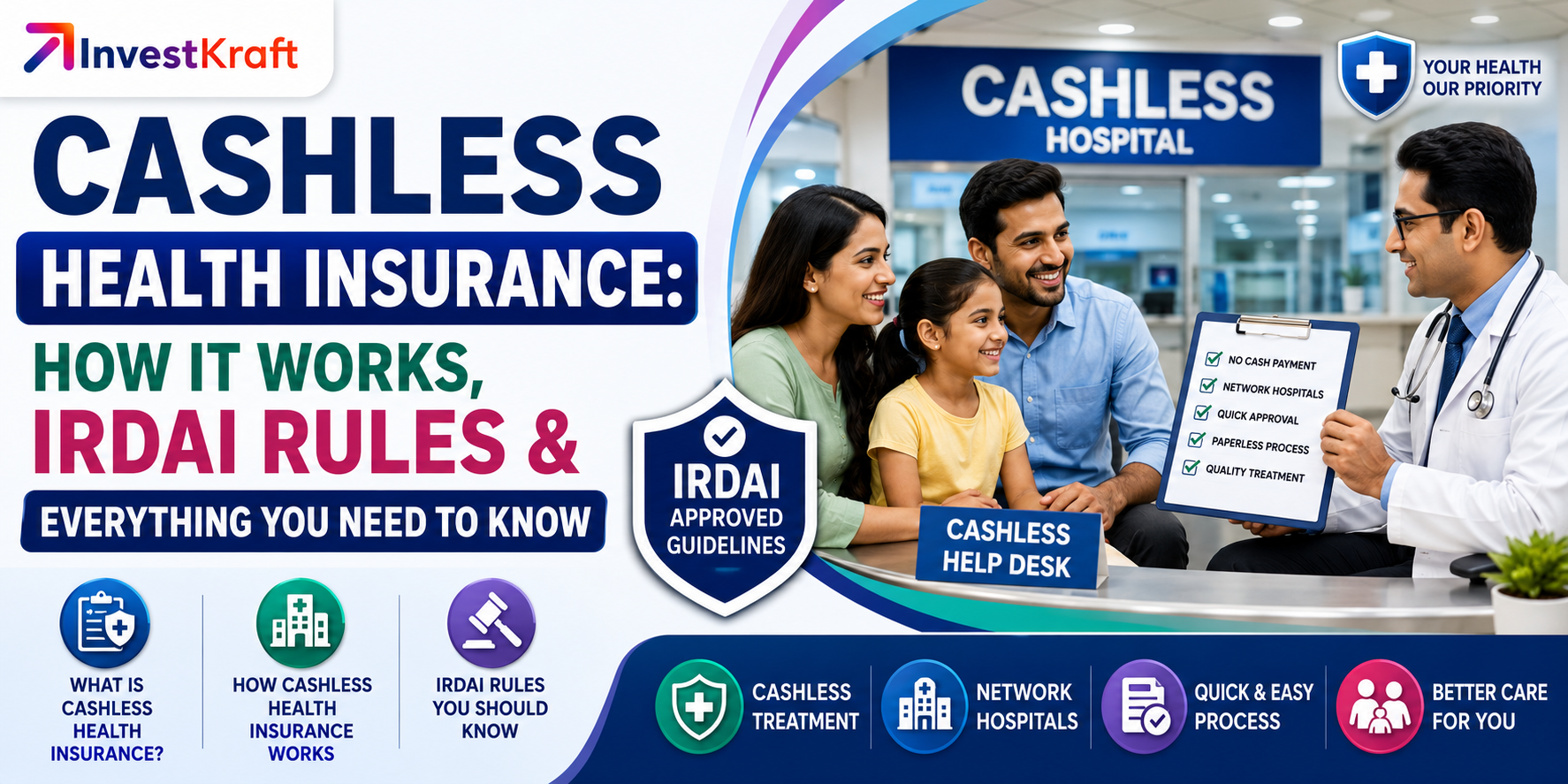
What is Cashless Health Insurance?
A facility where your insurer pays the hospital directly for covered treatment, so you don't pay upfront out of your own pocket
Where it applies?
Network hospitals by default
Non-network hospitals too, under the "Cashless Everywhere" initiative
Approval timeline
1 hour for pre-authorisation, 3 hours for final discharge, as mandated by IRDAI
Reimbursement claims, where you pay first and get reimbursed later
Please note that in cashless insurance, you still may pay for anything outside your policy's coverage - non-medical items, room upgrades beyond your limit, or excluded treatments - but the core treatment cost is handled between the insurer and the hospital.
How Does Cashless Health Insurance Work?
The following is the step-by-step guide on how cashless health insurance works:
Planned Hospitalisation Process
Choose a network hospital and inform your insurer or TPA at least 48 hours before admission
Show your health insurance card/e-card at the hospital's insurance desk
The hospital sends a pre-authorisation request to your insurer with estimated costs
The insurer reviews and approves (or queries) the request
You get admitted and treated without paying for covered expenses
At discharge, the hospital sends a final bill to the insurer for settlement
Emergency Hospitalisation Process
Get admitted immediately as treatment always comes first
The hospital or a family member informs the insurer/TPA, typically within 24–48 hours of admission
The insurer processes an emergency pre-authorisation, mandated to respond within 1 hour
Treatment continues on a cashless basis once approved
Final bill settlement happens at discharge, same as the planned process
IRDAI-Mandated Timelines: The 1-Hour and 3-Hour Rules
This is where things have genuinely improved for policyholders. Under IRDAI's Master Circular on Health Insurance Business, effective from July 31, 2024, insurers must decide on a cashless pre-authorisation request within one hour of receiving it, and grant final discharge authorisation within three hours of the hospital's request.
If an insurer misses the three-hour discharge window, it must bear any additional hospital charges arising from that delay - not the policyholder.
In the event of a policyholder's death during treatment, the insurer is also required to release the mortal remains without delay.
These are not just rules on paper.
Government data shared in the Lok Sabha in December 2025 showed roughly 87% of pre-authorisation requests were processed within one hour, and close to 97% of discharge authorisations were cleared within three hours, between August 2024 and May 2025 - a real, measurable improvement in how cashless claims are handled across the industry.
Cashless Everywhere: What Changed and What It Means for You Today
Since January 2024, the General Insurance Council's "Cashless Everywhere" initiative has extended cashless treatment to non-network hospitals as well, not just those on your insurer's approved list.
In principle, this means you can choose almost any hospital in India and still avoid paying upfront, subject to your insurer's approval and the claim being admissible under your policy terms.
In practice, it comes with real-world friction.
Some hospitals - especially smaller or non-network ones - still push back or ask patients to pay upfront, since the scheme is an industry-body initiative rather than a binding IRDAI regulation.
For elective procedures, you're still expected to inform your insurer at least 48 hours in advance; for emergencies, notification within 48 hours of admission is generally required. The safest approach is still to prioritise network hospitals wherever possible, and treat Cashless Everywhere as a valuable fallback rather than a guarantee.
Network vs Non-Network Hospitals: How Cashless Applies to Each
Network hospitals have a direct tie-up with your insurer or TPA, with pre-agreed treatment rates and a dedicated insurance desk - this is where cashless claims are fastest and most predictable.
Non-network hospitals can now offer cashless treatment too, under Cashless Everywhere, but approval isn't guaranteed, billing rates aren't pre-negotiated, and processing can take longer. When a choice exists, a network hospital remains the more reliable option.
Cashless vs Reimbursement Claims
Let us understand the differences between cashless claims and reimbursement claims
Parameter
Cashless Claim
Reimbursement Claim
Upfront payment
Not required for covered expenses
Full bill paid upfront by policyholder
Where applicable
Network hospitals (and non-network, via Cashless Everywhere)
Any hospital, network or not
Processing party
Insurer settles directly with hospital
Policyholder submits bills, insurer reimburses later
Approval timeline
1 hour (pre-auth), 3 hours (discharge)
Insurer must decide within 30 days
Convenience
High - minimal financial stress during treatment
Lower - requires arranging funds first
Documentation burden
Handled mostly by hospital/TPA
Policyholder collects and submits all documents
Types of Cashless Health Insurance Plans
The following are some of the cashless health insurance plans that are popular in India:
Individual Plans: Cashless cover for one person, sum insured dedicated entirely to them
Family floater Plans: Shared cashless sum insured across all family members on the policy
Senior citizen Plans: Cashless cover designed for older applicants, often with higher premiums and specific network hospital tie-ups
Group/corporate Plans: Cashless cover provided by an employer, usually with strong network access
Top-up Plans: Cashless cover that kicks in once your base policy's sum insured is exhausted
Pre-authorisation form (usually filled at the hospital's insurance desk)
Diagnosis and treatment estimate from the treating doctor
Previous medical records, if the condition is pre-existing or chronic
Role of TPA (Third Party Administrator) in Cashless Claims
A TPA is an intermediary appointed by your insurer to manage the claims process - verifying pre-authorisation requests, coordinating with the hospital, and processing settlements.
Not every insurer uses a TPA as some standalone health insurers handle claims in-house. Either way, the TPA (or insurer's claims team) is your point of contact if a cashless request is delayed.
Co-payment, Deductibles, Sub-limits & How They Affect Your Cashless Bill
Even with cashless approval, you may still owe money at discharge if your policy has:
Co-payment: You pay a fixed percentage of every claim. Example: a ₹2,00,000 bill with 10% co-payment means you pay ₹20,000, and the insurer settles ₹1,80,000 with the hospital.
Room-rent sub-limit: If your policy caps room rent at ₹5,000/day but you choose a ₹8,000/day room, the insurer proportionately reduces other charges too - not just the room rent difference - under what's called “proportionate deduction.”
Deductible: A fixed amount you bear before the insurer's coverage kicks in, common in top-up plans. A ₹1,00,000 deductible on a ₹3,00,000 bill means you pay the first ₹1,00,000, and cashless settlement applies only to the remaining ₹2,00,000.
Common Reasons Cashless Claims Get Rejected & How to Avoid Each
The following are some of the reasons why cashless claims get rejected, and how you can avoid them:
Treatment at an excluded or non-empanelled hospital: Verify the hospital's status before admission
Incomplete pre-authorisation form: Ensure the treating doctor fills in diagnosis details accurately
Claim falls within a waiting period: Check condition-specific waiting periods before assuming instant access
Treatment excluded under policy terms: Read the exclusion list carefully at purchase
Delayed intimation: Inform the insurer within the required window, especially for emergencies
What to Do If Cashless Treatment Is Denied - Fallback to Reimbursement
If cashless approval is denied or delayed beyond a point where you need immediate treatment, you can pay the hospital directly and file a reimbursement claim afterwards, provided the treatment itself is otherwise covered under your policy.
Keep every original bill, report, and prescription, since reimbursement claims are entirely documentation-dependent. Insurers are required to decide on reimbursement claims within 30 days of submission.
How to Choose a Health Insurer With Strong Cashless Support
The following are some of the parameters to choose the best health insurer:
Network size: A wider hospital network means more places you can access true, fast cashless treatment
Claim Settlement Ratio (CSR): Higher CSR generally signals a smoother claims experience, though it should be read alongside claim rejection reasons, not in isolation
Digital claim tools: Insurers with app-based pre-authorisation and real-time claim tracking tend to process cashless requests faster
Turnaround time (TAT) track record: Ask specifically about average pre-authorisation and discharge times, not just the regulatory minimums
Senior citizens often face longer underwriting scrutiny and sometimes co-payment clauses built into their plans by default.
The Cashless Everywhere initiative is particularly useful for this group, since it removes the pressure of finding a specific network hospital during an emergency.
When choosing a plan for parents or grandparents, prioritise insurers with strong senior-citizen-specific network hospitals and minimal co-payment terms.
Cashless Claims During Travel / Outside Home City
Cashless treatment is not restricted to your home city - it applies at any network hospital across India, and now, in principle, at non-network hospitals too under Cashless Everywhere.
If travelling, locate the nearest network hospital in advance where possible, and keep your insurer's emergency helpline handy, since intimation timelines still apply regardless of location.
Digital & App-Based Cashless Claims
Most major insurers now offer app-based pre-authorisation, real-time claim tracking, and digital document uploads - reducing the paperwork burden that traditionally slowed cashless approvals.
This digital push is part of why approval timelines have improved industry-wide since 2024.
A Real-World Example
Arjun, a 41-year-old IT professional in Gurugram, was travelling in Jaipur when his father suffered a cardiac event and needed emergency admission at a hospital that wasn't in his insurer's network.
Under the old system, this would have meant paying the entire bill upfront and filing for reimbursement weeks later. Instead, Arjun called his insurer's helpline, treatment began immediately, and the hospital's insurance desk filed a pre-authorisation request citing Cashless Everywhere.
Within the hour, the insurer confirmed provisional approval. By discharge, the full eligible bill of ₹3.4 lakh was settled directly with the hospital, apart from a small co-payment.
Arjun's policy required out-of-network claims. What used to be guaranteed financial stress during a medical emergency became a manageable, largely cashless experience.
Mistakes to Avoid With Cashless Health Insurance
The following are some of the mistakes to avoid with cashless health insurance:
Assuming every hospital offers cashless: Confirm before or during admission, especially for non-network hospitals
Skipping the 48-hour intimation window for planned procedures: This alone causes avoidable delays
Ignoring room-rent sub-limits: Higher room category than your policy allows can shrink your entire settlement, not just the room charges
Not reading co-payment and deductible clauses at purchase: These decide how much you will still owe even with approval
Forgetting to keep a backup file of bills and reports, in case anything needs separate reimbursement
Cashless Health Insurance Glossary
The following are some of the terms commonly used with cashless health insurance:
TPA (Third Party Administrator): Intermediary managing claims between you, the hospital, and the insurer
Pre-authorisation: Insurer's advance approval for cashless treatment based on estimated costs
Co-payment: A fixed percentage of the claim that you bear regardless of sum insured
Sub-limit: A capped amount within your sum insured for specific expenses like room rent
Network hospital: A hospital with a direct tie-up with your insurer for cashless treatment
Proportionate deduction: A reduction applied across your entire bill when you exceed your room-rent sub-limit
Myths vs Facts About Cashless Health Insurance
Now, let us take a look at some of the myths vs facts about cashless health insurance:
Myth: Cashless means 100% of every bill is covered. Fact: Co-payments, sub-limits, and exclusions can still mean you pay a portion out of pocket.
Myth: Cashless Everywhere makes every hospital in India a network hospital. Fact: It extends eligibility to non-network hospitals, but approval still depends on the insurer's assessment.
Myth: Cashless is always faster than reimbursement. Fact: Usually yes, but IRDAI's 1-hour and 3-hour rules are maximum timelines, not guarantees of instant approval.
Compare Top Insurers by Cashless Network & Claim Speed
Now, let us compare top insurers by their cashless networks and claim speed from the table below:
Cashless-focused OPD and hospitalisation combo plans
Disclaimer: Network numbers change frequently - always verify current figures directly with the insurer
Summary
Cashless health insurance removes the single biggest source of financial stress during a medical emergency: arranging money on the spot.
Thanks to IRDAI's 2024 Master Circular, insurers must now approve pre-authorisation within 1 hour and discharge within 3 hours - and the data shows most insurers are largely meeting that bar.
The Cashless Everywhere initiative has extended this benefit beyond network hospitals too, though it still works best when you plan ahead, understand your policy's co-payment and sub-limit terms, and keep documentation ready as a backup.
Frequently Asked Questions
Q1. What is cashless health insurance and how does it work?
It's a facility where your insurer pays the hospital directly for covered treatment, so you don't need to pay upfront out of pocket.
Q2. What is the difference between cashless and reimbursement claims?
Cashless means the insurer settles the bill directly with the hospital; reimbursement means you pay first and get reimbursed by the insurer afterward.
Q3. What is "Cashless Everywhere" and how is it different from regular cashless treatment?
It extends cashless eligibility to non-network hospitals across India, not just those on your insurer's approved list - though approval still depends on the insurer.
Q4. How long does cashless health insurance approval take in India?
IRDAI mandates 1 hour for pre-authorisation and 3 hours for final discharge authorisation, as of the 2024 Master Circular.
Q5. What should I do if cashless treatment is denied during a medical emergency?
Proceed with treatment, pay if necessary, retain all bills and documents, and file a reimbursement claim - insurers must decide on these within 30 days.
Sources
Angel One – Cashless Health Insurance Claim Authorisation: IRDAI's Rules and Data (2025)
Upstox – How Long Does Cashless Health Insurance Claim Authorisation Take in 2025
Ditto Insurance – Cashless Everywhere Initiative: How It Actually Works (2025)
General Insurance Council – Press Release: Launch of Cashless Everywhere
Axis Max Life – What Is Cashless Health Insurance? Benefits and How It Works
Outlook Money – Cashless Health Insurance: New Rule for Non-Network Hospitals
Disclaimer: This article is for informational purposes only and does not constitute financial or insurance advice. Cashless approval, co-payment terms, and network hospital lists vary by insurer and policy - please read your policy wording carefully or consult an InvestKraft advisor before purchasing. The insurer network-hospital counts in the comparison table are approximate figures from general market knowledge, not freshly verified per-insurer - worth a quick fact-check against each insurer's current numbers before this goes live, since those change often.
Author: Diwakar Kumar Singh
Diwakar Kumar Singh is a BFSI specialist and finance writer with over 7 years of hands-on experience in financial research, content creation, and analysis.
A Gold Medalist in MBA (Marketing) from IMT, he combines deep analytical skills with practical insights gained from evaluating companies, IPOs, unlisted shares, financial ratios, and investment opportunities. Diwakar has personally analysed hundreds of financial instruments and market scenarios, which he uses to break down complex topics into clear, actionable advice.
He has authored numerous in-depth finance articles, published multiple books internationally, and contributed to research publications. His work focuses on helping everyday investors and readers make better-informed financial decisions through well-researched, evidence-based explanations that are always grounded in real-world application rather than theory alone.


 care@investkraft.com
 +91-9599071040
 +91-9797971876